 |
| Diomedes Wounds Aphrodite, Arthur Fitger, 1905 |
Showing posts with label Iliad. Show all posts
Showing posts with label Iliad. Show all posts
Monday, September 16, 2013
Iliad - Book 5 ("Diomedes Fights the Gods")


Monday, 9/16 - The Ill-iad
| The Achilles Tendon |
- P&P
- Discuss Bks 4-6 and quotes
- "Hweat!" No, wrong language and epic . . . that's Beowulf. "Rage!" That's more like it ; )
HW: Read the next two books of Homer's Iliad (Bks 7 & 8) and finish J9 for Wednesday. I'll give you class time on Tuesday to do some work. "Thank you, Mr. Reno!" "You're welcome, my little warriors and warring weavers."
J9 – Heroes (97-114) – “The Rage of Achilles, Books 1-8”1. In what ways does Homer use Achilles to “trace out the consequences of extreme heroism”?
2. Although sideline characters in the Iliad, women’s role is crucial. How?
3. Explain how Achilles and Paris thematically occupy opposite end of the “heroic spectrum.”
4. Paris and Menelaus symbolize the clash of what opposites (there are several)?
5. The Greeks and Trojans almost establish a truce. Why does peace not prevail?
6. How do Paris and Achilles spatially occupy extreme positions in the Iliad (and where does Hector fall on that heroic continuum and why)?
7. What ancient practices does the scene between Diomedes and Glaucus highlight? What theme might it reinforce?
8. Comment on how the special division of the epic is also a gender division.
9. How, through Paris and Achilles, does Homer show that the two ends of the heroic spectrum curve around to meet?
10. How is Hector a true hero?
11. How is Hector more than a hero?
12. What does Homer achieve with his beautiful description of the “descent of darkness” (Heroes 112)?
Monday, September 9, 2013
Monday, 9/9 - Let the break dance fighting begin
- P&P
- Take notes on J8's reading assignment (Leithart's introduction to Homer's Iliad).
- Begin Homer's Iliad (this link is to our Fagles version; you'll have to wait a minute for it to download), and also begin reading Leithart for J9 (Due block day), "The Rage of Achilles, Books 1-8." If for some reason Fagles' version won't download for you, please use this link and read it until your Fagles arrives in the mail.
HW: Read one book of Homer's Iliad per day (journal will be due Monday, 9/16). In addition to the journal, I want you to select one favorite quote from each book; be ready either to link the quote to a larger theme, or explain why it's artistically delicious. So your homework for tomorrow will be to finish Book 1, record your favorite quote, and be ready to defend your selection. Cheers!
J9 – Heroes (97-114) – “The Rage of Achilles, Books 1-8”
1. In what ways does Homer use Achilles to “trace out the consequences of extreme heroism”?
2. Although sideline characters in the Iliad, women’s role is crucial. How?
3. Explain how Achilles and Paris thematically occupy opposite end of the “heroic spectrum.”
4. What opposites does the clash between Paris and Menelaus symbolize?
5. The Greeks and Trojans almost establish a truce. Why does peace not prevail?
6. How do Paris and Achilles spatially occupy extreme positions in the Iliad (and where does Hector fall on that heroic continuum and why)?
7. What ancient practices does the scene between Diomedes and Glaucus highlight? What theme might it reinforce?
8. Comment on how the special division of the epic is also a gender division.
9. How, through Paris and Achilles, does Homer show that the two ends of the heroic spectrum curve around to meet?
10. How is Hector a true hero?
11. How is Hector more than a hero?
12. What does Homer achieve with his beautiful description of the “descent of darkness” (Heroes 112)?
Thursday, September 5, 2013
Block, 9/5 - Quiz and ICE - Hesiod
*P&P
*Quiz and ICE
*Begin reading Heroes on Homer's Iliad.
HW: Read the following pages in Heroes and be prepared to discuss on Monday.
J8 – Heroes (85-96): “The Iliad –
Intro”
- According to the myths, how did the war begin?
- What part of the war is the Iliad about?
- What is the ancient Greek view of death?
- Describe the hero’s attitude toward death.
- What does Homer think of the “heroic ethic”?
- What accounts for the “despair” that, according to C. S. Lewis, pervades Homer’s epic?
- Explain the “geography” of the epic. Why is this spacial division important?
- Describe the “chiastic” links between Books 1-3 and Books 22-24.
- How are the structures of Books 1 and 24 connected?
- Describe some of the poetic techniques that Homer uses to unify the poem.
- Research and cite two facts about ancient Greek warfare that you find interesting (we’ll see if Homer's depiction of warfare reflects your facts).
Wednesday, October 3, 2012
Iliad - Book 6 ("Hector Returns to Troy")
 |
| The Fright of Astyanax (Hector Bidding Farewell to Andromache), Benjamin West, 1797 |
Tuesday, October 2, 2012

Monday, September 24, 2012
Monday, 9/24 - Journal review
*P&P
*Check J9
*Continue reading where you left off. J10 will be due sometime next week. Also, read through Book 10 by next Monday, but you can read more if you'd like.
J10 – Heroes (114-125)
– “The Love of Achilles, Books 9-17”
EQ: What heroic motivations does Homer explore in Books 9-17;
which one proves strongest?
1.
Agamemnon accepts no responsibility for having enraged Achilles.
Instead, he blames madness, the gods. How is this behavior a chink in the armor
of the heroic ethic?
2.
What is wrong with Agamemnon’s gift, his offer of reconciliation,
to Achilles? In other words, how is his huge offer an assertion of superiority?
3.
The messengers to Achilles speak to him with appeals to kleos and philos. Although he doesn’t join the war at the moment, what is
ironic—unexpected, given what we know and expect of him—about Achilles’ future
decision to join the war?
4.
How do Homer’s epic similes contribute thematically to Homer’s
understanding of warfare? (Think about the focus on animals and forces of
nature).
5.
Talk to me about the ancients’ understanding of boundaries,
addressing both the Greek and Christian understanding.
6.
In what way does Patroclus’ participation in the war “solve”
Achilles’ heroic dilemma?
7.
On
a related note, what is significant about Achilles’ armor? Cite several details
that explain your answer.
Wednesday, September 19, 2012
Wednesday, 9/19 - Achilles and Agamemnon break dance fight (Zoolander? I don't recommend it)
*P&P
*Go to Focus and to my online course to get the first three chapters to Fagles' translation of The Iliad.
*We pick up where we left off . . .
*Go to Focus and to my online course to get the first three chapters to Fagles' translation of The Iliad.
*We pick up where we left off . . .
HW: Since we will read more in class tomorrow, start J9, which I posted on yesterday's entry.
Monday, September 17, 2012
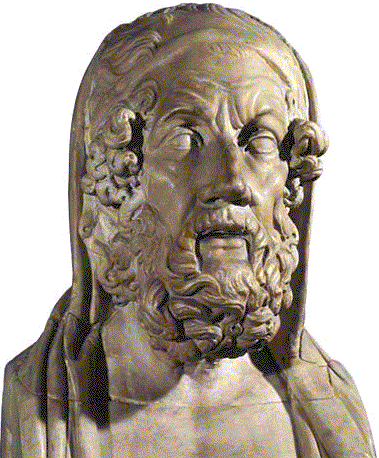
Monday, 9/17 - The Iliad and its background
*P&P
*Review J8
 *Begin Homer's Iliad and also begin reading Leithart for J9 (Due block day), "The Rage of Achilles, Books 1-8."
HW: Read the Iliad and Leithart.
*Review J8
 *Begin Homer's Iliad and also begin reading Leithart for J9 (Due block day), "The Rage of Achilles, Books 1-8."
HW: Read the Iliad and Leithart.
Subscribe to:
Comments (Atom)